
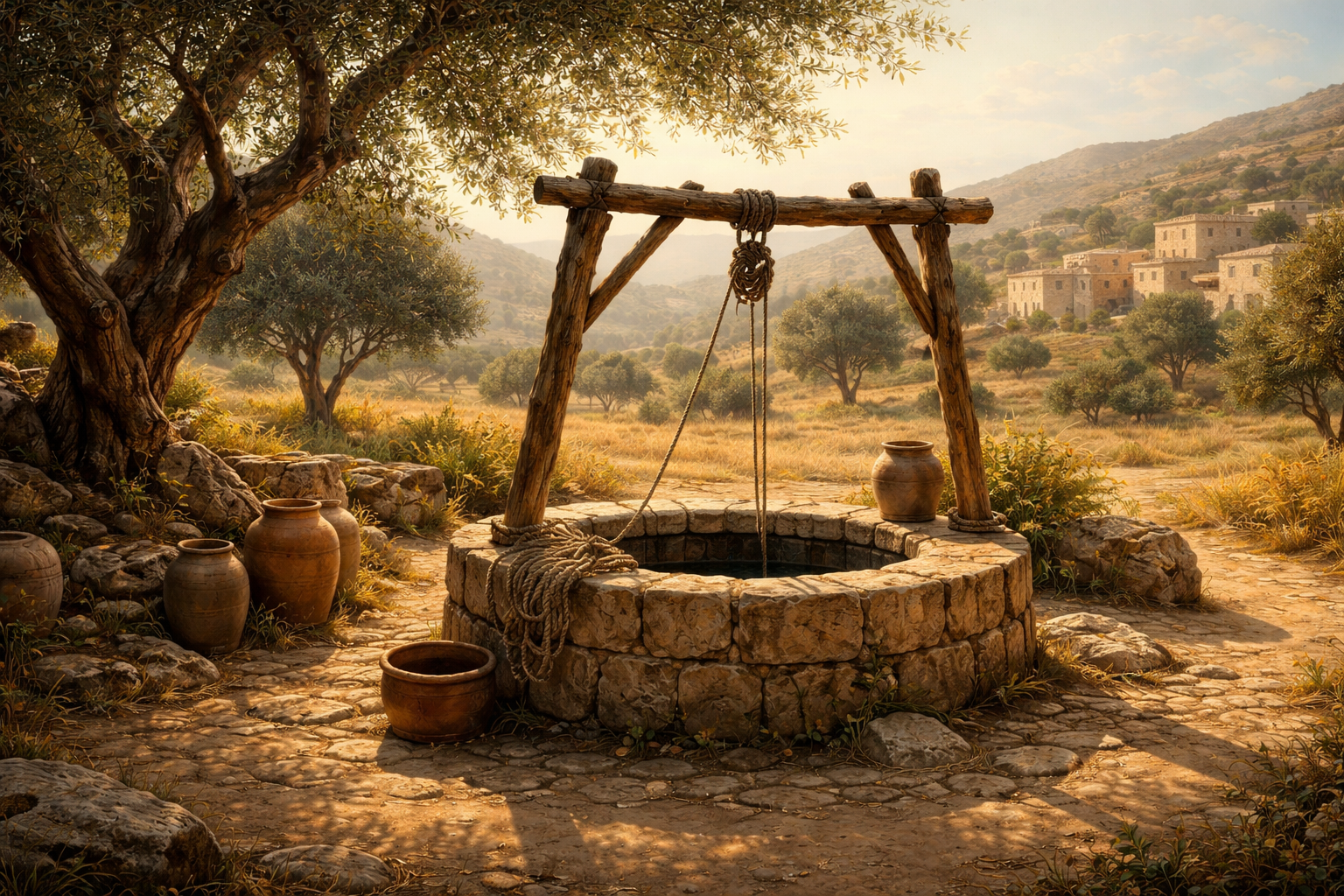
Read John 4:1-30 (The woman at the well).
Background
If you want a little cultural background for the story, take some time to read 2 Kings 17 and Jeremiah 2:13. These passages help explain why the conversation between Jesus and the Samaritan woman was so shocking.
The hostility between Jews and Samaritans didn’t start as a simple disagreement. It went back hundreds of years. When the northern kingdom of Israel was conquered (2 Kings 17), Assyria brought in people from across their empire to live in the land. Over time, their cultures, religions, and families blended with the Israelites who remained, forming the Samaritan people.
By Jesus’s day, Jews avoided Samaritans completely. They saw them as religiously compromised, ethnically mixed, and spiritually unclean. A Jewish traveler going north would walk miles out of the way just to avoid stepping foot in Samaria.
This makes Jesus’s choice to go through Samaria, and speak with a Samaritan woman, a direct challenge to generations of anger and prejudice.
Jeremiah 2:13 offers a vivid picture of the human heart. A cistern was basically a manmade pit for collecting rainwater, often muddy and stale. “Living water,” on the other hand, was fresh, flowing, and life-giving.
That image helps make sense of what Jesus says to the woman at the well. Through her relationships, her choices, and all the ways she tried to build a meaningful life on her own terms, she had been drinking from “broken cisterns,” things that could never satisfy the deep thirst inside her. Jesus wasn’t offering her another temporary fix. He was offering something completely different: a real, lasting, and cleansing life that she couldn’t find anywhere else.
Grace in Motion
Jesus didn’t have to pass through Samaria, geographically speaking. Most Jews made a habit of avoiding the region altogether. The history between Jews and Samaritans was long, bitter, and deep enough that people literally made their travel plans around avoiding each other. But John tells us Jesus “had to” go through Samaria. That points to something deeper.
Jesus arrives at Jacob’s well around noon, the hottest part of the day when the well is usually silent. Women normally came early in the morning or late in the evening, when it is cooler and they gathered water together. The timing of this woman’s visit reveals something right away: she isn’t avoiding the sun; she is avoiding the people. She’s avoiding the whispers, the judging eyes, and the constant reminders of her past.
When Jesus speaks to her, everything in her braces for disappointment or danger. Jewish men don’t talk to Samaritan women. Rabbis don’t start conversations with people whose reputations are complicated and messy. And strangers don’t cross social, religious, or moral boundaries so casually. Yet Jesus does. Grace that knows no bounds crosses every line and sits at the well beside her, beginning a conversation she never expected.
She answers cautiously, with the practiced politeness of someone who has learned to stay guarded. While her wounds don’t show on the surface, they’ve certainly shaped her every instinct, especially the instinct to sidestep vulnerability and protect herself from being seen too clearly.
When Jesus presses into her story, she does what hurting people often do: she changes the subject. Quickly. She shifts to a religious debate: Where should we worship? Which mountain is right? What do Jews say? What do Samaritans teach? Anything to keep the conversation from circling back to the painful parts of her life.
Many of us still do the same thing today. When Jesus gets too close to the places we would rather not face, we reach for distractions. Detours feel safer than honesty.
But Jesus doesn’t shame her for avoiding the truth, and He doesn’t force her to confess. His presence is calm and steady, guiding her to the moment where the truth can no longer stay hidden. He brings her story into the light to show her it’s possible to be known completely and still loved completely. That’s where grace and truth meet.
Even still, the grace He offers her comes at a cost. He risks His reputation. He crosses boundaries His people have respected for centuries. He accepts the judgment of anyone who might see Him speaking with a Samaritan woman alone. Grace is free to receive, but rarely cheap to give.
And slowly, something shifts. She begins to realize this isn’t a stranger out to use her story against her. This isn’t another man taking advantage of her past. This is Someone who knows everything she has ever done and still refuses to take a step back. There is no rejection in His voice and no disgust in His tone. Just the offer of Living Water for a soul that has been thirsty for years.
By the time she leaves the well, she isn’t avoiding people anymore. She runs back to the village she once hid from and tells anyone who will listen, “Come and see a man who told me everything I ever did!” The very parts of her story she tries to hide become the very evidence of grace working in her life.
When Jesus crosses into Samaria, He shows that His grace isn’t bound by the lines people draw. Today, His grace is no different. And what Jesus offered the woman at the well is the same thing He offers to you: love that knows everything about you and still doesn’t take a step back; mercy that doesn’t flinch at your past; and grace that meets you not where you wish you were, but where you actually are.
He never takes the long road around you. His grace still crosses every barrier and sits with you in the heat of the day. If He was willing to go through Samaria to reach her, He will go wherever He needs to reach you. And He won’t stop until your deepest thirst is met in Him.
Reflect & Respond
What does it reveal about Jesus that He went through Samaria instead of avoiding it?
What does Jesus’s honesty about her story show you about His heart?
Why do you think she stayed in the conversation instead of walking away?
How does Jesus hold truth and grace together in a way people rarely do?
How does this story reshape your idea of who belongs with Jesus?
Comments
No comments yet. Be the first.
Leave a comment